
Video Deduplication: Batch-Process Footage to Lower Duplicate-Content Flags
Date Published

Distributing the same footage to multiple accounts or platforms is a recipe for "reposted duplicate" flags and throttling. Video Deduplication bundles a set of treatments into one batch process: every account receives a visually differentiated version, automating a foundational step of matrix distribution.
Hoe het werkt
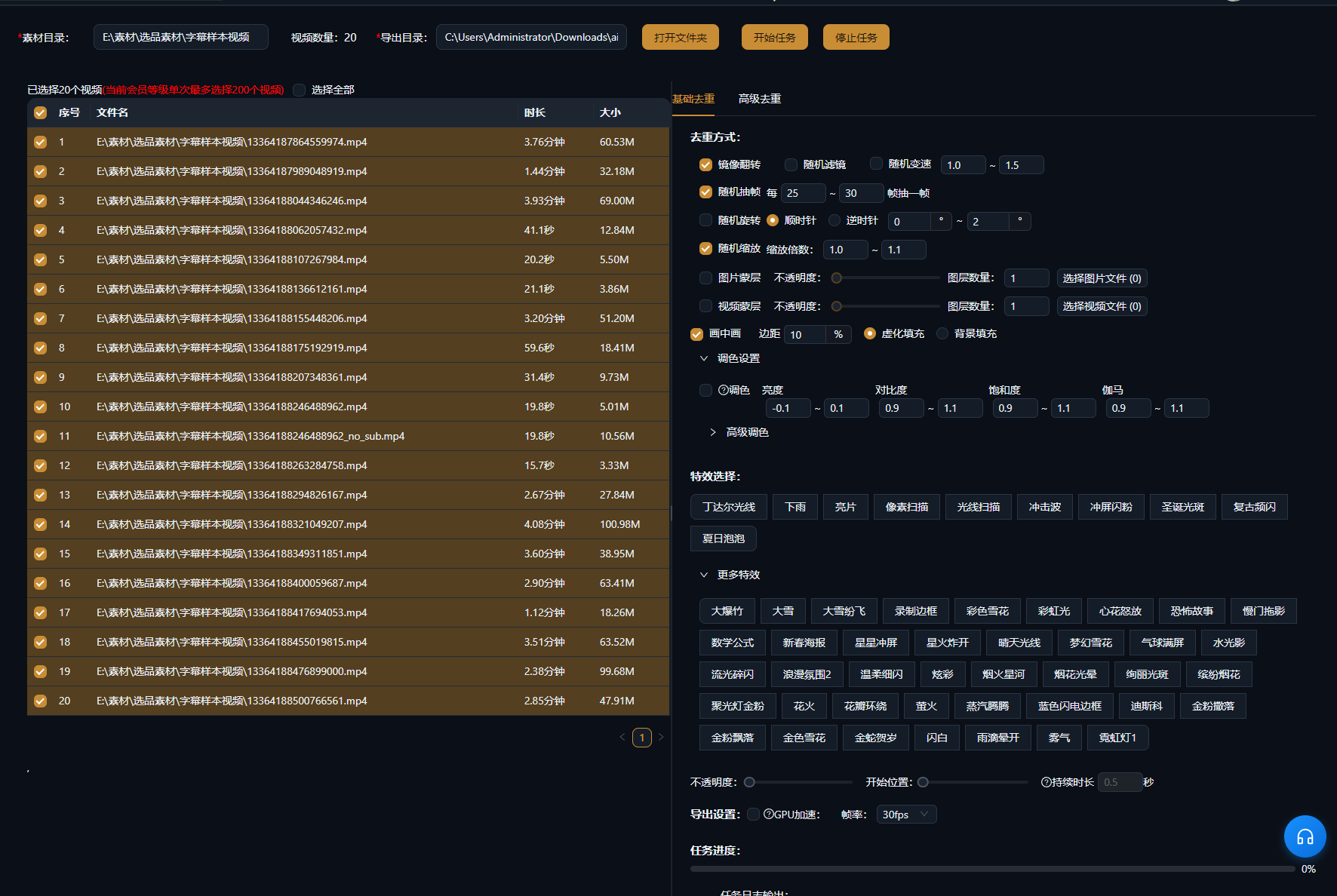
Import videos to process
Batch-import the footage you plan to distribute; process a single clip or an entire set.
Choose a deduplication combo
Freely combine mirror flips, cropping, speed changes, noise, and color tweaks, each with adjustable intensity.
Export in batches and distribute
One click batch-processes and outputs multiple versions; pair with batch editing to send each version to its account.
Praktijkvoorbeelden
De vijf scripts hieronder zijn echte resultaten van AIMIX AI-scriptcreatie, gegenereerd met de prompt uit elk voorbeeld. Ze zijn in het Chinees gegenereerd; de tabellen zijn ongewijzigd vertaald en de duur is zoals gegenereerd. Een scène zonder gegenereerde beeldbeschrijving is gemarkeerd met „—”.
Local-Life Matrix: Run 10 Accounts Safely on One Set of Footage
Best for: Local-life content, product recommendations, business account matrices · Distributing one source video across many accounts
Workflow: Final cut → Deduplication batch → Per-account distribution → Data collection
Set it once, process the whole batch · Differences between versions are barely visible · Plugs into the batch-editing pipeline
The reality of matrix operations: output is finite, accounts are not. Deduplication lets one set of quality footage cover more accounts while every version keeps its "independent content" fingerprint.
How to Choose Among Common Deduplication Techniques
Each technique affects the viewing experience differently; combining them works best:
Mirror flip
Flips the frame left to right; use with care on text-heavy or strongly directional shots.
Cropping
Slightly trims the edges to change the framing ratio with almost no visible impact.
Speed changes
Micro speed shifts between 0.9x and 1.1x are invisible to the eye but change the file fingerprint.
Noise and color
Light noise plus subtle white balance and brightness tweaks widens the gap between versions.
We recommend combining at least three techniques and spot-checking the versions for a consistent look before export.
Houd controle over de montage
Batch processing saves time and effort
No manual per-clip tweaking — configure once and export the whole batch.
Controllable differentiation
You control the processing intensity, balancing differentiation against visual quality.
Infrastructure for matrix distribution
Pairs with batch editing and batch voiceover for a complete multi-account content pipeline.
Veelgestelde vragen
Does deduplication reduce video quality?
Light processing barely affects quality; excessive noise or cropping will degrade it, so keep the combination moderate.
Does processing guarantee the video will not be flagged as a duplicate?
Deduplication lowers the risk of duplicate flags, but platform rules change constantly and no absolute guarantee is possible.
Can I process the video without touching the audio?
Yes — video and audio processing are independent, so choose only what you need.
How many versions can one video produce?
Different parameter combinations yield multiple versions; see the desktop client's batch settings for specifics.
Can deduplication and batch editing be used together?
Yes — both live in the batch workflow, and edit-first, deduplicate-second is the common order.
How fast is processing?
Batch jobs run as a queue; typical-length short videos usually finish the whole batch quickly.